Know Which Solar Risks Matter Most
Operational and financial risk assessment built for solar teams that need clarity before risk gets expensive.
Protect production. Improve recovery. Reduce hidden exposure.
Reference Architecture: Low Impact Solar Site
Example OT / IT segmentation and remote access model with illustrative NERC CIP low-impact alignment labels.
Reference only. Not a compliance determination.
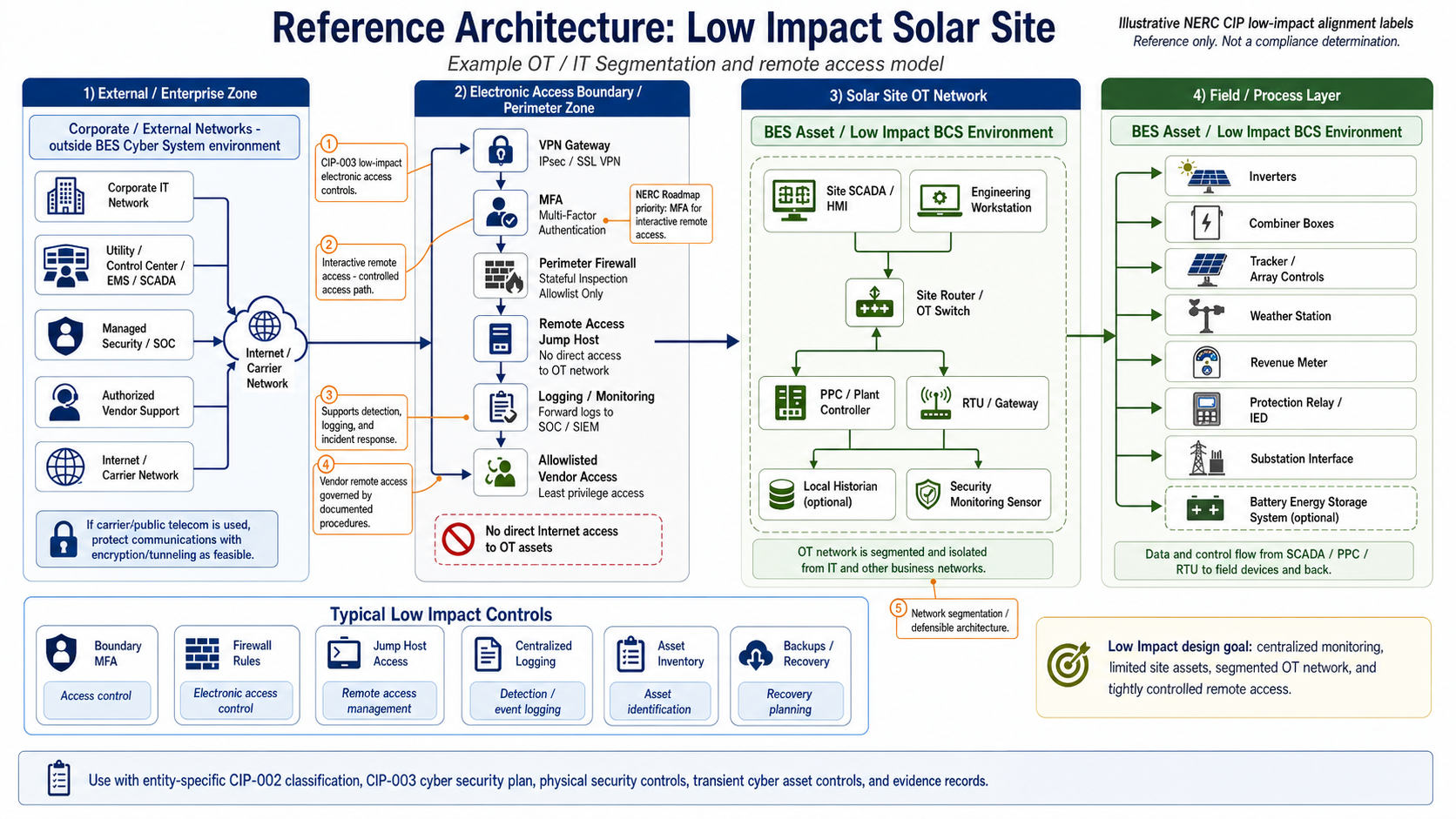
Zone 1: External / Enterprise
Corporate IT, Utility EMS/SCADA, Managed SOC, Authorized Vendors
Zone 2: Electronic Access Boundary
VPN Gateway, MFA, Perimeter Firewall, Jump Host, Logging
Zone 3: Solar Site OT Network
BES Asset / Low Impact BCS: SCADA/HMI, PPC, RTU/Gateway
Zone 4: Field / Process Layer
Inverters, Trackers, Meters, Protection Relay, BESS
Typical Low Impact Controls
Boundary MFA
Access control
Firewall Rules
Electronic access control
Jump Host Access
Remote access mgmt
Centralized Logging
Detection / event logging
Asset Inventory
Asset identification
Backups / Recovery
Recovery planning
Use with entity-specific CIP-002 classification, CIP-003 cyber security plan, physical security controls, transient cyber asset controls, and evidence records.
Solar Risk Pilot Project
A focused engagement to validate risk assessment methodology and demonstrate measurable outcomes for your solar operations.
Pilot Objectives
- Validate reference architecture against your site configuration
- Identify top 3-5 operational risk scenarios with financial impact
- Develop prioritized remediation roadmap with cost-benefit analysis
Pilot Deliverables
- Site-specific risk assessment report with FAIR quantification
- Gap analysis comparing current state to reference architecture
- Executive summary for stakeholder and investor communication
Ready to Start a Pilot?
Schedule a 30-minute call to discuss your site, timeline, and how a pilot engagement could reduce your operational risk exposure.
What's Actually at Risk
Operational Fragility
Hidden dependencies on specific hardware, firmware versions, and third-party integrations that create single points of failure.
Access & Identity
Uncontrolled vendor access, weak credential management, and unclear authorization boundaries across development, operations, and support teams.
Telemetry & Control Systems
Inadequate monitoring, blind spots in real-time telemetry, and delayed visibility into equipment performance and anomalies.
Third-Party Dependencies
Cascading risk from software suppliers, firmware vendors, and SaaS platforms that operators don't directly control.
How We Assess Solar Risk
1Hardware & Firmware Dependencies
We map the actual hardware stack, firmware versions, and hardware-specific vulnerabilities that create operational fragility.
2Access & Identity Control
We audit how developers, operations teams, vendors, and integrators access systems, then map the risk of uncontrolled or orphaned access paths.
3Telemetry & Visibility
We evaluate real-time monitoring, alerting, and the visibility gaps that delay problem detection and slow recovery.
4Financial Impact (FAIR Model)
We quantify probable business loss using the FAIR framework—not just technical severity, but actual revenue at risk and recovery cost.
Why FAIR? Because leadership needs to understand probable business loss, not just technical severity labels.
Why look beyond hardware performance? Because it examines the operational, access, telemetry, and vendor dependencies that affect uptime and recovery.
Who This Is For
Developers
Building solar control systems and operational tools
Asset Managers
Managing portfolios of distributed solar projects
Owner-Operators
Running single or multi-site solar installations
Investors
Evaluating operational resilience and hidden cost exposure
Is this only for owner-operators? No. It is built for developers, asset managers, owner-operators, and investors who need a clearer view of operational fragility and hidden cost.
Do you only assess, or do you help implement?
SecureStepPartner can support both the initial assessment and the follow-on remediation path. You choose the depth and timeline.
Why FAIR for Solar?
- ✓Move beyond technical severity labels to probable business loss
- ✓Quantify the financial impact of operational downtime and recovery delays
- ✓Prioritize controls based on real business consequences, not just vulnerability counts
- ✓Justify security investments to leadership and investors with credible financial narratives
Know Which Solar Risks Matter Most Before They Get Expensive
SecureStepPartner helps solar teams identify hidden operational exposure, test realistic loss scenarios, and quantify the business impact of technical and third-party dependencies.
Protect production. Improve recovery. Reduce hidden exposure.